Your money isn’t broken. The system holding it hostage is.
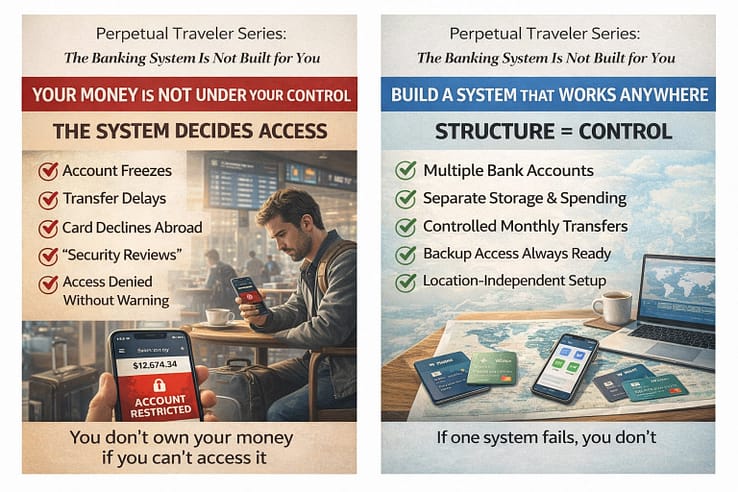
You think your bank works for you.
It doesn’t.
It tolerates you—until you step outside the lines.
Travel too much. Move money differently. Live internationally.
Then suddenly… your “access” becomes a privilege.
This isn’t a glitch.
It’s the design.
Read this article for free here
This Isn’t About Travel
This is about control.
The modern banking system is built for predictability:
- One country
- One address
- One income stream
- One tax jurisdiction
The second you break that model, friction shows up:
- Accounts flagged
- Transfers delayed
- Cards frozen
- Questions asked
You didn’t do anything wrong.
You just stopped behaving like a compliant domestic consumer.
That’s the problem.
What a Perpetual Traveler Actually Is
A perpetual traveler doesn’t just move physically.
They restructure how money moves.
At its core, it’s this:
- Intentional movement → You are not tied to one system
- System-based living → You design around friction, not react to it
- Location flexibility → Your money works regardless of where you are
The difference?
You stop asking, “Will my bank allow this?”
And start asking, “How do I structure this so it doesn’t matter?”
What It Isn’t
Let’s kill the fantasy:
 This is not “digital nomad freedom”
- This is not “open a random offshore account and disappear”
- This is not avoiding responsibility
 This is not “digital nomad freedom”
This is about control, redundancy, and access.
Because if one account freezes—and it will eventually—
You’re done if that’s your only pipeline.
Thinking about doing this yourself? Start Here
Get a free step-by-step breakdown of how to structure your life, income, and location so this actually works.
Why the Banking System Breaks When You Travel
Here’s the reality most people never see:
Banks are not built for mobility.
They are built for regulation compliance and risk containment.
That means:
- They don’t like “unusual patterns”
- They don’t like cross-border activity
- They don’t like inconsistent locations
You know what qualifies as “unusual”?
Living your life internationally.
So what happens?
- You land in a new country → card decline
- You move money → “review pending”
- You login from a different IP → account flagged
And then you get the email:
“We’ve temporarily restricted your account for your protection.”
No.
They restricted it for theirs.
How to Work Around It (The Real Way)
You don’t fight the system.
You route around it.
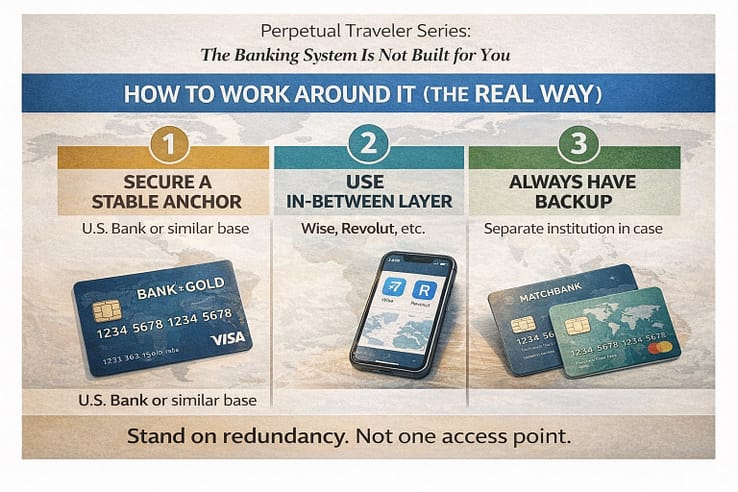
Here’s the structure that actually works:
1. Multiple Banking Layers (Non-Negotiable)
You need at least:
- Primary U.S. bank (anchor)
- International transfer platform (Wise / Revolut type)
- Backup account (separate institution)
Why?
Because one WILL fail at some point.
If you have one account, you’re exposed.
If you have three, you’re operational
Separate Storage from Spending
Big mistake people make:
They keep everything in one place.
Correct approach:
- Store funds in a stable account
- Move only what you need monthly
This does two things:
- Limits exposure
- Reduces “suspicious activity” patterns
You become boring to the system.
That’s exactly what you want.
Control the Flow, Not Just the Money
It’s not about how much you have.
It’s about how it moves.
You want:
- Predictable monthly transfers
- Clean transaction patterns
- Minimal random spikes
Why?
Because randomness = risk flag.
Structure beats chaos every time
Accept That You Are the Risk Variable
The system isn’t changing.
You are the variable.
So either:
- You keep living like a domestic user → constant friction
- Or you build a system that anticipates problems
Most people react after they get locked out.
That’s too late
Why This Is Happening Now
This didn’t matter 20 years ago.
Now it does.
Because:
- Everything is digitized
- Monitoring is automated
- Cross-border movement is tracked
At the same time:
- Cost of living is rising
- People are leaving high-cost countries
- Remote income is increasing
Translation:
More people are breaking the system’s assumptions.
And the system is pushing back.
Who This Is For (And Who It Isn’t)
This is for:
- People leaving high-cost environments
- People living internationally 3–12 months at a time
- People who want control over their money, not permission
This is NOT for:
- People who want convenience over control
- People who panic when something breaks
- People who expect the system to adapt to them
Because it won’t.
The Shift Most People Miss
Most people think:
“I need a better bank.”
Wrong.
You need a better structure.
No single bank will fix this.
No single app will solve it.
Because the issue isn’t the tool.
It’s the model.
Once you understand that:
- You stop relying on one access point
- You stop trusting “it’ll be fine”
- You start building redundancy
And suddenly…
You’re not stressed when something freezes.
You just switch lanes and keep moving.
Bottom Line
The banking system was never designed for someone like you.
It was designed for:
- Stability
- Predictability
- Compliance
You are choosing:
- Movement
- Flexibility
- Independence
Those two things don’t naturally align.
So you don’t force it.
You outgrow it.

John Rebell
John Rebell- Perpetual Traveler & Systems Strategist
I help people design location-independent lives that actually work—financially, logistically, and long-term.
This isn’t about escaping. It’s about structuring your life so you don’t have to.
Get a free step-by-step breakdown of how to structure your life, income, and location so this actually works. Sign up below.
