One gives you freedom. The other gives you obligations. Most people choose wrong.
Everyone’s chasing the “right visa.”
Long-term. Residency. Something official.
It sounds smart. Responsible. Stable.
But most people jump into long-term visas way too early—before they even understand the game they’re stepping into.
You’re Not Choosing a Visa—You’re Choosing a Position
This isn’t about travel.
It’s about geoarbitrage—using different countries to optimize how you live, spend, and operate.
And visas are just the mechanism that lets you exist inside that system.
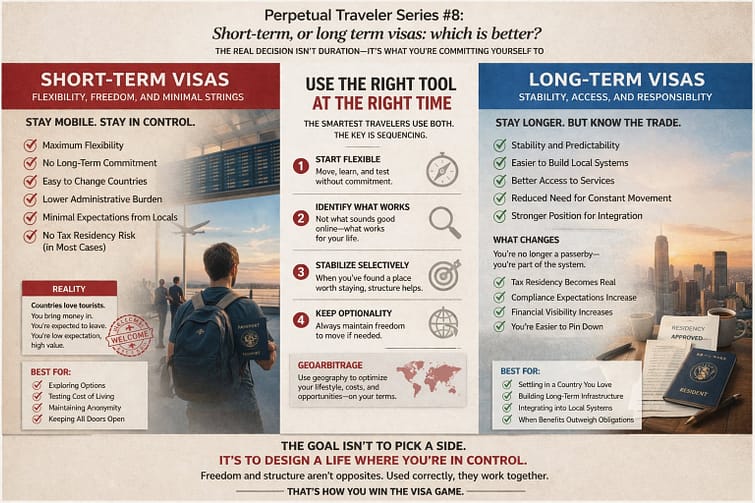
Short-term visas = flexibility.
Long-term visas = commitment.
That’s the real distinction.
Once you see that clearly, the decision stops being confusing.
Short-Term Visas: The Tourist Advantage Nobody Talks About
Short-term visas are underestimated.
Not because they’re powerful on paper—but because of how they’re treated in reality.
When you’re on a tourist visa (or visa-exempt entry), you’re low expectation.
- You’re not expected to understand every local law
- You’re not expected to integrate
- You’re not expected to participate in the system
You’re passing through.
And here’s the part most people miss:
Countries like tourists.
Tourists bring money in.
They don’t take resources out long-term.
They don’t create administrative burden.
From a government perspective, you’re simple.
That simplicity is leverage.
You can:
- Enter and exit cleanly
- Adjust locations quickly
- Avoid getting entangled in local systems too early
Short-term visas give you room to learn without consequences stacking up.
Long-Term Visas: Stability Comes With Strings
Long-term visas look attractive because they remove friction.
You can stay longer.
You can sign leases.
You can open accounts more easily.
But what rarely gets talked about is what comes with that “freedom.”
Responsibility.
The moment you shift into long-term status, you’re no longer a passerby.
You’re now part of the system.
That means:
- Tax exposure becomes real
Many countries trigger tax residency based on time (often 180 days or similar thresholds) - Compliance expectations increase
You’re expected to understand and follow local rules—ignorance doesn’t fly anymore - Financial visibility increases
Banking, income flows, and activity can come under more scrutiny - You’re easier to pin down
You now exist in a defined jurisdiction, not floating between them - If you have children who are draft age, they may be conscripted into the military.
- You may have to put up a sizable amount of money to qualify.
Not to mention your money can now the trapped inside a foreign country.
This is the trade- off
You gain stability—but you lose flexibility and anonymity.
And if you don’t fully understand the system you’re entering, you can create problems you didn’t need to have.
The Mistake: Locking In Before You Know
A lot of “gurus” push long-term visas as the goal.
Residency. Elite visas. Retirement visas. “Golden” visas.
They frame it as leveling up.
But here’s the reality:
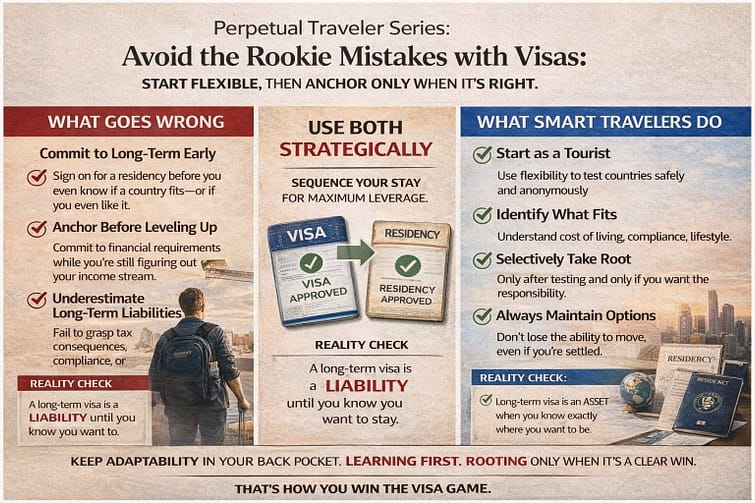
If you don’t yet know where you want to be long-term, a long-term visa is a liability.
Not an asset.
Because you’re committing to:
- A tax system you may not understand
- A cost structure you haven’t fully tested
- A lifestyle you haven’t lived long enough to evaluate
You’re anchoring before you’ve explored.
That’s backwards.
Thinking about doing this yourself? Start Here
Get a free step-by-step breakdown of how to structure your life, income, and location so this actually works.
Use the Right Tool at the Right Time
This isn’t a debate between short-term vs long-term.
They’re both tools.
The mistake is treating one as “better” instead of understanding when to use each.
When Short-Term Makes Sense
- You’re exploring countries or regions
- You’re testing cost of living vs income
- You’re learning how systems actually work on the ground
- You want maximum flexibility
Where most people are right now.
Short-term is your discovery phase.
You stay light.
You stay mobile.
You gather real-world data.
When Long-Term Makes Sense
- You’ve found a place that fits
- You understand the local rules and costs
- You’re ready to integrate (at least partially)
- The benefits outweigh the obligations
Long-term is your optimization phase.
Now stability helps you—not traps you.
What Actually Changes When You Cross the Line
This is the cleanest way to understand it:
Tourist = tolerated and welcomed
Resident = accountable and visible
As a tourist:
- You’re expected to leave
- Your footprint is temporary
- Your obligations are minimal
As a resident:
- You’re expected to comply
- Your footprint is tracked
- Your obligations increase
Neither is “better.”
But they are very different positions.
And most people don’t realize they’ve changed positions until after the fact.
The Smarter Sequence
Instead of picking one side, use both strategically.
- Start as a tourist
Move around. Learn. Test locations. Keep everything flexible. - Identify what actually works
Not what sounds good online—what works for your life. - Then consider long-term options
Only when you understand the trade-offs and actually want them. - Keep optionality alive
Even with a long-term visa, don’t box yourself in completely.
This is how you stay in control.
Final Thought
Short-term visas give you freedom.
Long-term visas give you structure.
Freedom without structure becomes chaos.
Structure without understanding becomes a trap.
The goal isn’t to pick one.
It’s to use both—intentionally.
Because once you understand geoarbitrage, you realize something simple:
You’re not just choosing where to live.
You’re choosing how much control you keep.

John Rebell
John Rebell- Perpetual Traveler & Systems Strategist
I help people design location-independent lives that actually work—financially, logistically, and long-term.
This isn’t about escaping. It’s about structuring your life so you don’t have to.
Download a FREE step by step blueprint of exactly how to set your life up to be legal, free, and in charge of your own life.
