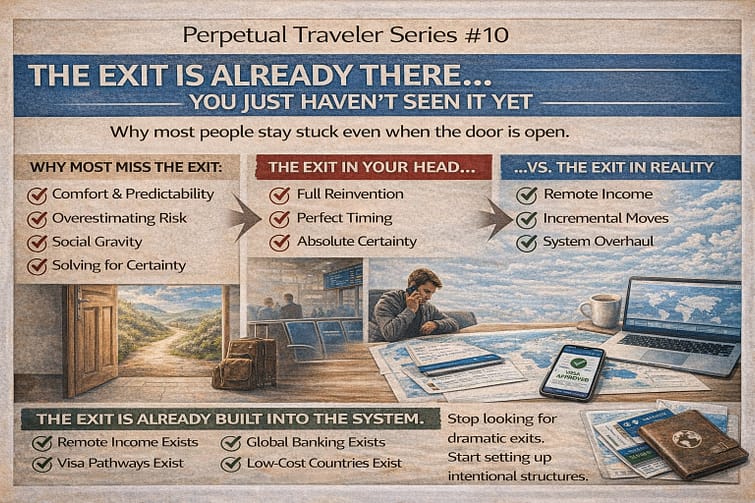
Why most people stay stuck even when the door is open
Thinking about doing this yourself? Start Here
Get a free step-by-step breakdown of how to structure your life, income, and location so this actually works.
You’re Not Trapped. You’re Patterned.
Most people aren’t stuck because they can’t leave.
They’re stuck because they don’t recognize what leaving actually looks like.
They’re waiting for a dramatic moment. A clean break. A perfect plan.
That moment doesn’t come.
Meanwhile, the exit has been sitting there the entire time, quiet, unannounced, and completely usable.
The Exit Doesn’t Look Like an Exit
People imagine “getting out” as some big, visible move:
- Selling everything
- Quitting the job
- One-way ticket
- Total reinvention
That’s not how it works.
The real exit is subtle. It starts with small structural changes:
- Moving income online, even partially
- Reducing fixed costs
- Testing time abroad instead of committing to it
- Creating flexibility instead of forcing decisions
The door isn’t locked.
You just keep walking past it because it doesn’t match the picture in your head.
The Real Problem: You’re Solving for Certainty
Most people don’t need more information.
They need less attachment to certainty.
They want:
- Guaranteed income before they move
- Perfect location before they test
- Full legal clarity before they take step one
That mindset keeps you in place.
Because the system you’re trying to leave runs on certainty.
Salary. Lease. Routine. Predictability.
You don’t transition out of that by demanding more of the same.
You transition by building options.
What This Actually Looks Like in Practice
This isn’t theory. It’s a process.
Here’s what the “exit” usually looks like when it’s done correctly:
- You keep your current income, but start shifting how it’s earned
- You travel short-term instead of relocating permanently
- You test countries instead of committing to one
- You build systems before you need them
Nothing dramatic happens.
But six months later, your life is completely different.
Not because you “escaped.”
Because you restructured.
Most People Stay Because the Old Model Still Works
Let’s be honest.
For most people, the current system isn’t failing.
It’s just…tight.
- Bills are covered
- Income is stable
- Life is predictable
That’s enough to stay.
But not enough to expand.
So they sit in this middle ground:
Uncomfortable, but functional.
That’s the hardest place to leave from.
Because nothing is forcing you out.
Thinking about doing this yourself? Start Here
Get a free step-by-step breakdown of how to structure your life, income, and location so this actually works.
The Invisible Barriers That Keep You in Place
It’s not logistics.
It’s not money.
It’s not visas.
Those can all be solved.
What actually keeps people stuck:
1. Identity
You’ve spent years building a life that makes sense on paper.
Leaving it—even partially—feels like breaking something that “works.”
2. Social Gravity
Everyone around you is operating on the same model.
Step outside of it, and you lose reference points.
That’s uncomfortable.
3. Overestimating Risk
People assume leaving is dangerous.
In reality, staying in a system that limits your options is the bigger long-term risk.
4. Underestimating Simplicity
They think it’s complex.
It’s not.
It’s just unfamiliar.
What Changes Once You See It
Once you recognize the exit, something shifts.
You stop asking:
“How do I get out?”
And start asking:
“How do I structure this so I’m not stuck anymore?”
That’s a completely different question.
And it leads to completely different decisions:
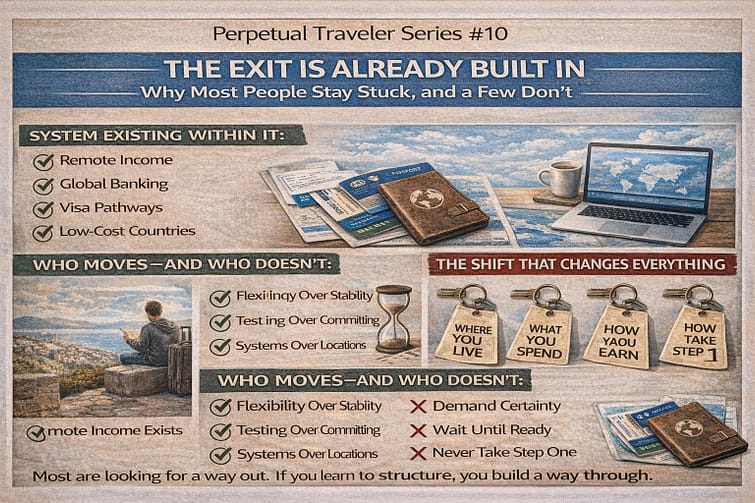
- You choose flexibility over stability
- You prioritize systems over locations
- You test instead of committing
- You move incrementally instead of all at once
This is where most people miss it.
They’re looking for a way out.
When what they actually need is a way through.
The Exit Is Already Built Into the System
Here’s the part most people don’t realize:
The same system that keeps you in place also gives you the tools to leave.
- Remote income exists
- Global banking exists
- Visa pathways exist
- Low-cost countries exist
Nothing is hidden.
Nothing is blocked.
It’s all available.
But it requires a different way of thinking:
You stop playing by default.
And start structuring intentionally.
Who Moves—and Who Doesn’t
The people who make this shift aren’t smarter.
They’re not richer.
They’re not more connected.
They just do one thing differently:
They act before they feel ready.
Not recklessly.
But incrementally.
They test.
They adjust.
They move again.
Everyone else waits.
And waiting is what keeps them in place.
The Shift That Changes Everything
This isn’t about leaving your country.
It’s not about travel.
It’s not about freedom in the abstract.
It’s about control.
Control over:
- Where you live
- What you spend
- How you earn
- How you structure your life
Once you see that, the idea of “being stuck” starts to fall apart.
Because you realize:
You were never locked in.
You just hadn’t looked at the system from the right angle.Final Thought
There’s no big moment where the door swings open.
No signal.
No permission.
Just a series of small decisions that move you closer to optionality.
The exit isn’t something you find.
It’s something you recognize.
And once you see it, you can’t unsee it.

John Rebell
John Rebell- Perpetual Traveler & Systems Strategist
I help people design location-independent lives that actually work—financially, logistically, and long-term.
