Why earning more inside a broken structure never fixes the problem
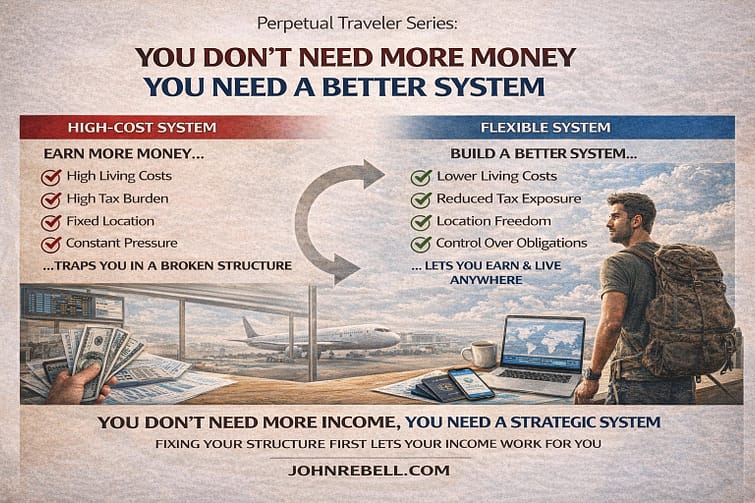
Most people are solving the wrong problem.
They chase more income…
inside a system that quietly drains it.
So nothing changes.
They just run faster.
The Real Constraint Isn’t Income—It’s Structure
This conversation usually starts the same way:
“I just need to make more.”
No—you don’t.
Because if your expenses, taxes, location, and obligations are all locked into a high-cost system, then increasing income doesn’t free you. It just raises the ceiling on how much pressure you can تحمل.
You’re still trapped inside the same framework.
- Same cost of living
- Same tax exposure
- Same geographic limitations
- Same dependence on one system
You just get a slightly nicer version of the same cage.
What Actually Changes the Game
A perpetual traveler doesn’t focus on income first.
They focus on structure.
That means designing your life around leverage instead of effort.
Here’s what that looks like in practice:
- Geographic arbitrage → Earn in one market, live in another
- Tax positioning → Reduce exposure legally instead of accepting it blindly
- Mobility → Avoid long-term commitments until they make sense
- System-first thinking → Build flexibility before scaling income
Income still matters—but it’s secondary.
Because once the structure is right, income requirements drop dramatically.What Most People Get Wrong
They try to brute-force their way out.
Work more hours.
Take on more clients.
Chase higher-paying roles.
And sometimes it works—temporarily.
But here’s what happens:
- Higher income → higher expectations
- Higher income → lifestyle inflation
- Higher income → deeper entrenchment
Now you need that income just to maintain your position.
You didn’t solve the problem.You reinforced it.
Thinking about doing this yourself? Start Here
Get a free step-by-step breakdown of how to structure your life, income, and location so this actually works.
The Environment Has Changed—Most People Haven’t
We’re in a different world now.
- Remote income is normal
- Geographic flexibility is possible
- Cost differences between countries are massive
But behavior hasn’t caught up.
People still anchor themselves to one location…
one system…
one way of doing things.
but because they haven’t questioned it.
Who Moves Forward With This—and Who Doesn’t
This works if you’re willing to think structurally.
- You value flexibility over tradition
- You’re open to changing how life is organized
- You want control more than comfort
It doesn’t work if:
- You need everything predictable
- You’re tied to one place by default
- You want the benefits without changing the setup
This isn’t better or worse.
It’s just a different approach.
The Quiet Advantage Most People Miss
Here’s where everything flips:
When your structure improves, your required income drops.
Not because you’re cutting everything down—but because you’re removing inefficiency.
- Lower baseline expenses
- Better positioning
- Fewer forced obligations
Now income becomes leverage.
Not survival.
And once that happens, you stop chasing money—and start using it.
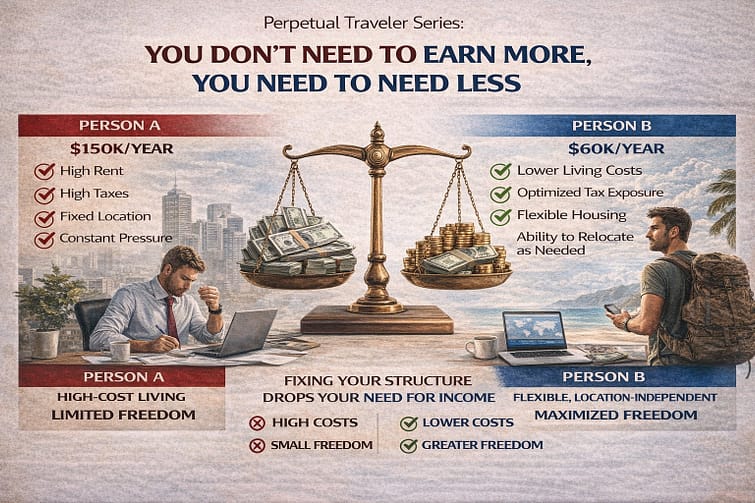
A Simple Comparison
Two people.
Same skill level.
Different systems.
One earns $150K tied to a high-cost environment.
The other earns $60K with flexibility built in.
The first one carries weight:
- Fixed expenses
- Limited movement
- High pressure
The second one carries options:
- Adjustable costs
- Mobility
- Room to pivot
Who has more freedom?
It’s not the one with the bigger number.
And once you see it this way, you can’t unsee it.
What This Really Comes Down To
You don’t fix a broken system by feeding it more.
You fix it by changing how it’s built.
Once that’s done:
- Income stretches
- Pressure drops
- Choices expand
And everything starts working the way it should have in the first place.

John Rebell
John Rebell- Perpetual Traveler & Systems Strategist
I help people design location-independent lives that actually work—financially, logistically, and long-term.
