How to structure accounts so you’re not locked to one country
You don’t realize it at first.
You think you’re traveling. You think you’re free.
But every time you need to move money, access funds, or prove where you “live”… you hit friction.
That friction isn’t random. It’s control.
And it’s coming from your banking structure.
The Hidden Anchor Most People Ignore
Most people carry their financial life like they never left home.
Same bank. Same country. Same assumptions.
That works fine—until you try to operate globally.
Then the cracks show up fast:
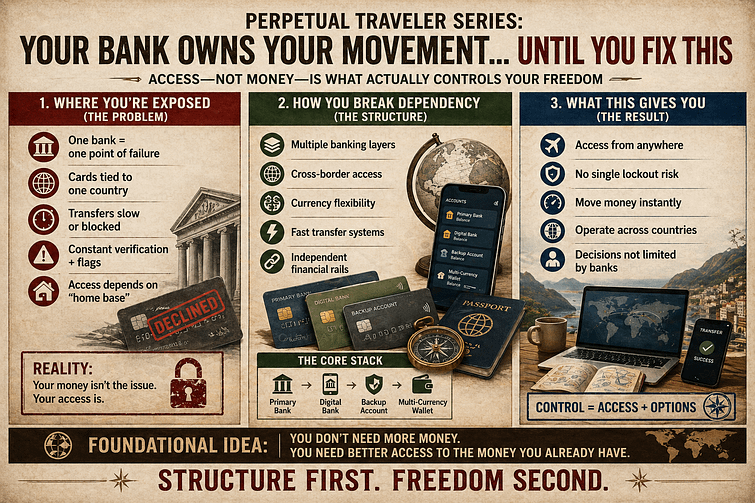
- Cards get flagged or frozen
- Transfers take days (or get blocked)
- Logins trigger security alerts
- You’re constantly proving who you are and where you are
It’s not because you’re doing anything wrong.
It’s because your financial system was never designed for movement.
It was designed for stability inside one jurisdiction.
You’re Not Mobile If Your Money Isn’t
You can change countries overnight.
Your bank can’t.
That’s the core problem.
If your money is tied to one country, one institution, and one compliance system, then your movement is conditional.
You’re free… until you need access.
That’s when the system reminds you who’s actually in control.
If your visa is weak, unstable, or misunderstood… your entire plan is weak.
The Fix Isn’t Complicated—But It Is Intentional
You don’t need offshore shells, complicated structures, or anything shady.
You need redundancy and flexibility.
That’s it.
Here’s what that looks like in practice:
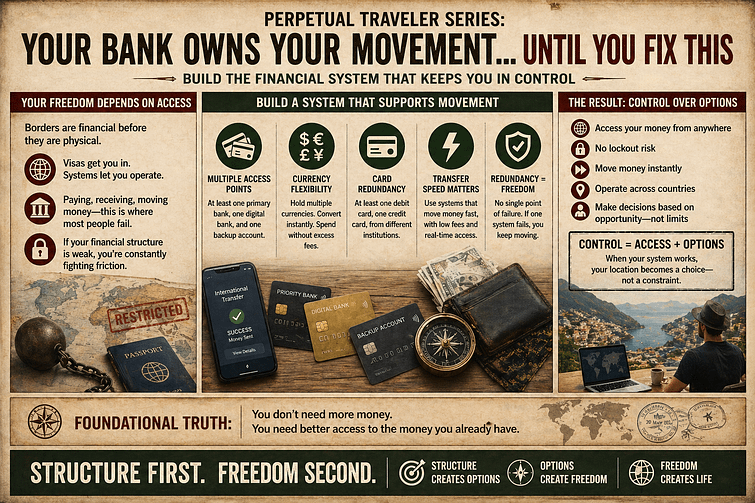
1. Multiple Access Points
You should never rely on one bank.
At minimum:
- One primary bank (home country)
- One international-friendly digital bank
- One backup account that’s separate from both
If one locks you out, you don’t stop moving.
2. Currency Flexibility
Holding only one currency creates exposure.
Not just to exchange rates—but to access.
You want the ability to:
- Hold multiple currencies
- Convert instantly
- Spend without excessive fees
This isn’t optimization. It’s operational stability.
3. Card Redundancy
One card is a liability.
Two is basic.
Three is safe.
You should have:
- At least one debit card
- At least one credit card
- Ideally from different institutions
Because cards fail. Systems flag. Machines reject.
You don’t want to be figuring that out at an ATM in a foreign country.
4. Transfer Speed Matters
Traditional banks are slow.
That’s fine when you’re not moving.
It’s a problem when you are.
You need at least one system that allows:
- Fast international transfers
- Real-time currency conversion
- Low friction between accounts
Time matters when you’re operating across borders
The Real Risk Isn’t Losing Money—It’s Losing Access
Most people think in terms of “Is my money safe?”
Wrong question.
The real question is:
Can you access it when you need it, from anywhere?
Because if you can’t, it doesn’t matter how “safe” it is.
You’re stuck.
And that’s the exact situation most people unknowingly create.
Thinking about doing this yourself? Start Here
Get a free step-by-step breakdown of how to structure your life, income, and location so this actually works.
Borders Are Financial Before They’re Physical
People think borders are about visas.
They’re not.
They’re about systems.
You can physically enter a country easily in many cases.
Operating inside it financially? That’s where most people fail.
- Paying rent
- Receiving income
- Moving money in and out
- Avoiding unnecessary fees and delays
If your financial structure isn’t built for that, you’re constantly working against friction.
That’s not freedom.
That’s dependency with better scenery.
Simplicity Wins—But Only If It’s Structured
This isn’t about building complexity.
It’s about removing single points of failure.
A simple, well-structured setup beats a complicated one every time.
The goal is:
- Access from anywhere
- Multiple ways to move money
- No reliance on one system or country
Once that’s in place, everything else gets easier.
Travel. Living. Decision-making.
Because you’re not asking, “Can I afford to move?”
You’re asking, “Where do I want to go next?”
It was luck.
Who Actually Needs to Fix This
Not everyone.
If you live, work, and plan to stay in one country long-term, your current setup is probably fine.
But if you’re:
- Moving between countries
- Earning or spending internationally
- Exploring relocation or long-term travel
- Building a location-independent life
Then this isn’t optional.
It’s foundational.
Without it, everything else becomes harder than it needs to be.
This Is Where Control Shifts
Most people try to solve this too late.
They wait until something breaks.
A frozen account. A blocked transfer. A declined card.
Then they scramble.
That’s reactive.
The better move is to set it up before you need it.
Because once your financial system supports movement, something shifts.
You stop thinking like someone who’s “away from home.”
And start operating like someone who isn’t tied to one.
And once you see it this way, you can’t unsee it.

John Rebell
John Rebell- Perpetual Traveler & Systems Strategist
I help people design location-independent lives that actually work—financially, logistically, and long-term.
