The difference between fantasy and strategy
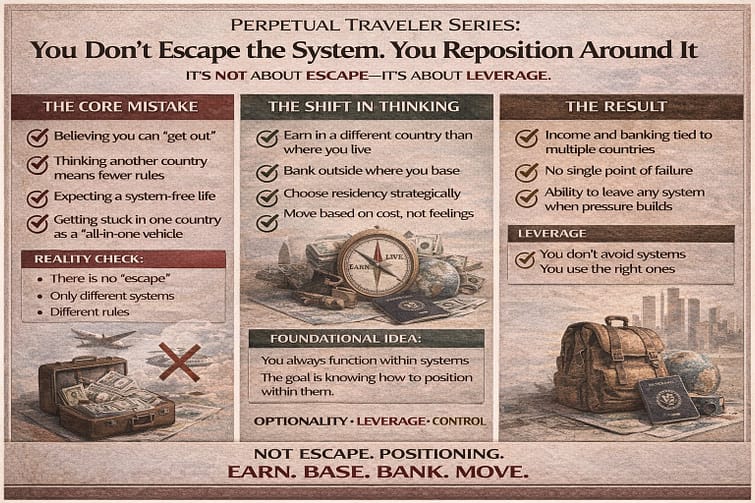
Most people think the goal is to escape the system.
Different country. Different rules. Clean break.
That’s not how this works.
You don’t escape anything.
You just learn where to stand.
Stop Trying to “Get Out”
“Getting out” is the wrong objective.
There is no version of life where systems stop applying to you.
You don’t reach some invisible line where rules disappear.
What actually happens is this:
You leave one system… and immediately enter another.
Different tax structure.
Different visa requirements.
Different banking limitations.
Different cost structures.
If you don’t understand that, you’re not escaping, you’re just rotating through problems.
What Actually Changes (And What Doesn’t)
When you move countries, a few things change fast:
- Cost of living
- Lifestyle options
- Access to services
- Day-to-day friction
What doesn’t change:
- You still need income
- You still operate inside legal frameworks
- You still depend on financial systems
- You’re still accountable somewhere
That’s the disconnect.
People expect a structural reset.
What they get is a structural shift.
The Real Skill: Placement
This is where the game actually is.
Not in leaving—but in placing yourself correctly.
A perpetual traveler looks at the world differently:
- Which countries reward short-term presence?
- Which banking systems are easiest to operate across borders?
- Where does my income stretch the furthest?
- Where am I least exposed?
This isn’t about finding “better.”
It’s about finding alignment.
Why Most Attempts Fall Apart
People try this once, usually the wrong way.
They pick a country based on:
- Lifestyle appeal
- YouTube videos
- Cost of rent
And ignore everything else.
Then reality shows up:
- Visa limits
- Tax complications
- Banking friction
- Long-term sustainability
So they either go home…
Or convince themselves it “didn’t work.”
It wasn’t the idea that failed.
It was the lack of structure.
Thinking about doing this yourself? Start Here
Get a free step-by-step breakdown of how to structure your life, income, and location so this actually works.
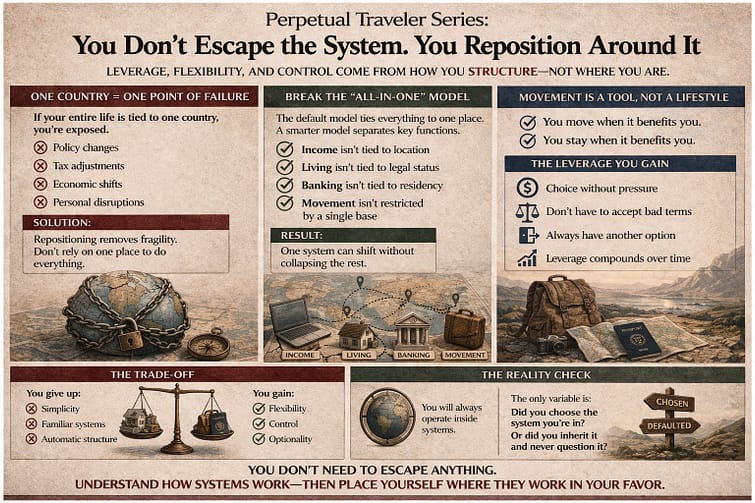
One Country Is a Single Point of Failure
Here’s the part most people never think about:
If your entire life is tied to one country, you’re exposed.
- One policy change
- One tax adjustment
- One economic shift
- One personal disruption
And everything moves at once.
That’s normal—until you see another option.
Repositioning removes that fragility.
You stop relying on one place to do everything.
Breaking the “All-in-One” Model
The default model looks like this:
Live, earn, bank, and exist—all in the same country.
That’s convenient.
It’s also limiting.
A repositioned structure separates those functions:
- Income isn’t tied to location
- Living isn’t tied to legal status
- Banking isn’t tied to residency
- Movement isn’t restricted by a single base
Now you’re not dependent on one system holding everything together.
Mobility Without Chaos
This is where people misunderstand the concept.
They think it means constant motion.
Always moving. No stability.
That’s not the point.
You move when it benefits you.
You stay when it benefits you.
Mobility gives you the option—not the obligation.
There’s a difference.
The Leverage Most People Never Reach
Once you’re positioned correctly, you gain something most people never experience:
Choice without pressure.
You’re not forced to:
- Stay in a high-cost environment
- Accept bad financial terms
- Remain in a system that doesn’t serve you
Because you’ve already built alternatives.
That’s leverage.
And it compounds over time.
The Bottom Line
This isn’t complicated—but it is unforgiving.
If you ignore the visa side of this, it will eventually catch up to you.
Always.
But if you build around it?
Now you have something most people never get:
Freedom that actually holds up in the real world.
And once you see it this way, you can’t unsee it.

John Rebell
John Rebell- Perpetual Traveler & Systems Strategist
I help people design location-independent lives that actually work—financially, logistically, and long-term.
