The risk nobody thinks about until it hits
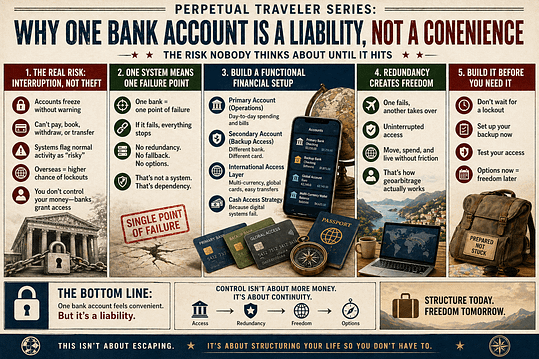
Most people think simplicity is smart.
One bank. One account. Everything in one place.
Clean. Easy. Organized.
It works—right up until the moment it doesn’t.
And when it breaks, it doesn’t break slowly.
It shuts down immediately and you're locked out of your money.
Convenience Is Not the Same as Control
A single bank account feels efficient because it reduces friction.
One login. One card. One system.
But what you’re actually doing is centralizing your entire financial life into a single point of failure.
That’s not efficiency. That’s exposure.
Banks freeze accounts. It happens every day. Not because you did something wrong—because their systems flagged something unusual.
- International login.
- Unusual transaction.
- New device.
- Cross-border transfer.
From their perspective, they’re protecting themselves.
From your perspective, you’re locked out of your own life.
The Real Risk Isn’t Theft—It’s Interruption
People focus on fraud protection.
That’s not the real issue.
The real risk is access.
If your account gets restricted—even temporarily—you lose the ability to:
- Pay for a hotel
- Book a flight
- Withdraw cash
- Move money between accounts
If you’re in your home country, it’s an inconvenience.
If you’re overseas, it’s a problem.
If you’re moving between countries, it’s a shutdown.
This is where most people realize too late—they don’t actually control their money. They have permission to use it.
One System Means One Failure Point
Think of your bank account like infrastructure.
Would you build a business with a single server and no backup?
Of course not.
But that’s exactly how most people structure their finances.
One bank = one failure point.
If it goes down, everything goes down with it.
No redundancy. No fallback. No options.
That’s not a strategy. That’s dependency.
The System Most People Never See
There’s a layer to this that casual travelers never notice.
Countries track behavior patterns:
- How often you enter and exit
- How long you stay each time
- Whether your movement looks structured—or suspicious
If you’re bouncing in and out without a clear legal path, eventually you get flagged.
Not immediately. Not dramatically.
But one day:
“Why are you here again?”
“How long are you staying?”
“Where is your return ticket?”
That’s when people realize:
This isn’t a game you can bluff your way through.
Thinking about doing this yourself? Start Here
Get a free step-by-step breakdown of how to structure your life, income, and location so this actually works.
What a Functional Setup Actually Looks Like
You don’t need complexity. You need structure.
At minimum, your financial system should have separation of roles:
Primary Account (Operations)
This is your day-to-day account. Bills, spending, subscriptions.
Secondary Account (Backup Access)
Different bank. Different card. Ideally in a different system entirely.
International Access Layer
Something that works globally without friction:
- Multi-currency accounts
- Debit cards that function across borders
- Ability to move money without delays
Cash Access Strategy
Because digital systems fail. Always have a way to access physical currency when needed.
This isn’t about having more accounts.
It’s about not relying on one.
Geographic Movement Changes the Rules
If you stay in one country your entire life, you can get away with a fragile setup.
The system is built around you.
Once you start moving, that changes.
Now you’re interacting with:
- Different banking regulations
- Different fraud detection systems
- Different transaction patterns
- Different currencies
From a bank’s perspective, your behavior looks irregular.
From your perspective, you’re just living normally.
That mismatch is where problems start.
The Illusion of Stability
People trust their bank because it’s always worked.
Until it doesn’t.
The system doesn’t fail gradually. It fails instantly.
Card declines.
Login blocked.
Account under review.
No warning.
No timeline.
And no one you can call who can fix it immediately.
You’re not dealing with a person. You’re dealing with a system.
And systems don’t care about your situation.
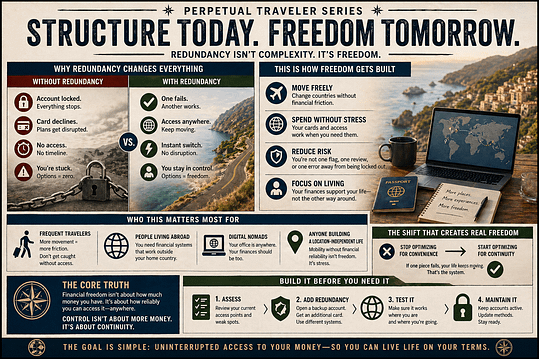
Redundancy Is Freedom
Freedom isn’t about having more money.
It’s about having uninterrupted access to the money you already have.
That comes from redundancy.
When one system fails, another takes over.
No stress. No scrambling. No disruption.
You don’t notice the failure—because it doesn’t affect you.
That’s the goal.
And once you see it this way, you can’t unsee it.
This Is Where Geo-arbitrage Actually Works
Everyone talks about lowering cost of living.
Fewer people talk about maintaining financial continuity while doing it.
You can live well in a lower-cost country.
But only if your financial system supports that lifestyle.
If your access is fragile, your lifestyle is fragile.
And that defeats the entire purpose.
A strong setup lets you:
- Move freely
- Spend without friction
- Shift locations without financial disruption
That’s when geoarbitrage becomes real—not just theoretical.
Who This Breaks First
This setup fails fastest for people who:
- Travel frequently
- Live outside their home country
- Depend on digital payments
- Don’t have local banking options where they are
In other words, the exact people trying to build a location-independent life.
The more mobile you are, the more fragile a single-account system becomes.
The Shift Most People Never Make
Most people optimize for simplicity.
One account. One system. One path.
But simplicity without structure is just hidden risk.
The shift is this:
- Stop thinking in terms of convenience.
- Start thinking in terms of continuity.
Can your financial life keep functioning if one piece fails?
If the answer is no, you don’t have a system.
You have a dependency.
Build It Before You Need It
The worst time to fix this is after something goes wrong.
Because now you’re trying to rebuild access without access.
That’s where people get stuck.
Accounts locked. Cards declined. Transfers blocked.
And no immediate way out.
The right time to structure this is when everything is working.
That’s when you have options.
The Bottom Line
One bank account feels clean.
It feels organized.
It feels efficient.
But it’s a liability.
Not because something will definitely go wrong—but because if it does, you have no buffer.
No fallback.
No control.
And once you start moving between countries, that’s not a risk worth taking.

John Rebell
John Rebell- Perpetual Traveler & Systems Strategist
I help people design location-independent lives that actually work—financially, logistically, and long-term.
