The order matters—and most people get it wrong
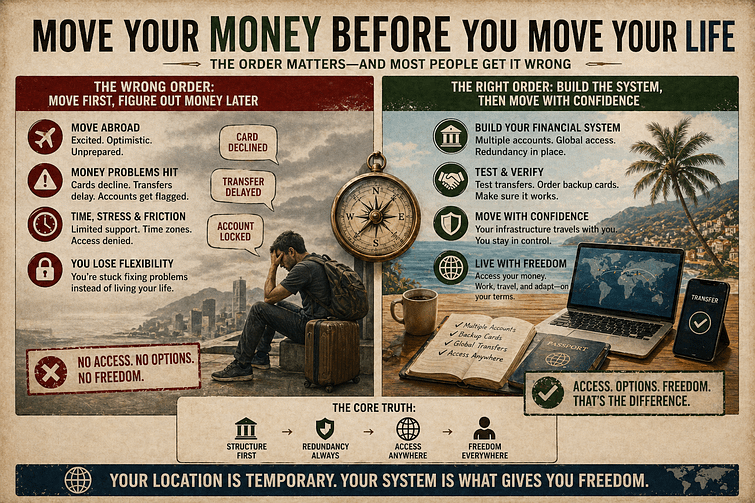
Most people plan the move first.
Country. Apartment. Visa. Flights.
Then they figure out the money.
That’s backwards—and it’s where the friction starts.
The Real Problem Isn’t Location—It’s Financial Infrastructure
You can land in the perfect country and still be stuck.
Why?
Because your money is still tied to the system you just left.
- One domestic bank
- One debit card
- One point of failure
- One compliance trigger away from “access denied”
You didn’t move your life.
You just changed your physical location.
Your financial system stayed behind.
That disconnect creates problems fast—especially when you’re dealing with international transactions, fraud flags, or simple things like logging into your account from another country.
You either understand it… or it handles you.
The Real Problem Isn’t Location—It’s Financial Infrastructure
You can land in the perfect country and still be stuck.
Why?
Because your money is still tied to the system you just left.
- One domestic bank
- One debit card
- One point of failure
- One compliance trigger away from “access denied”
You didn’t move your life.
You just changed your physical location.
Your financial system stayed behind.
That disconnect creates problems fast—especially when you’re dealing with international transactions, fraud flags, or simple things like logging into your account from another country.
Mobility Without Access Is Not Freedom
You don’t need millions to live internationally.
You need access.
Access to your funds. Access to transfers. Access to backup options.
That means your structure has to come first.
Before you book a flight, you should already have:
- Multiple bank accounts (not all in one country)
- At least one global fintech option (like Wise or Revolut)
- Redundant debit/credit cards
- A clean, simple transfer flow between accounts
This isn’t complicated. But it is intentional.
You’re building a system that works regardless of where you are.
Not one that works only when you’re “home.”
Why Timing Matters More Than People Think
Here’s what usually happens:
Someone moves abroad.
Everything works fine for a few weeks.
Then something small breaks:
- Card declines
- Account login flagged
- Transfer delayed
- Bank wants verification they can’t easily provide
Now they’re dealing with it from another country.
Different time zones. Limited support. No physical branch.
What could have been handled easily back home becomes a multi-day problem.
That’s not a crisis.
But it’s friction—and it compounds.
When your money is set up first, these issues don’t stop your movement. They become minor inconveniences instead of blockers.
This isn’t a game you can bluff your way through.
Thinking about doing this yourself? Start Here
Get a free step-by-step breakdown of how to structure your life, income, and location so this actually works.
Build the System While It’s Easy
There’s a window where this is simple.
That window is before you leave.
While you still have:
- A stable address
- Easy access to banking support
- Clear identity verification
- No international flags on your accounts
Use that.
Open accounts. Test transfers. Order backup cards.
Make sure everything works before you rely on it.
Because once you’re moving, you don’t want to be troubleshooting infrastructure.
You want to be using it.
The Minimum Viable Setup
You don’t need a complex offshore structure.
You need a functional one.
At a basic level:
- Primary account (home country)
This is your anchor. Income flows here. - Secondary account (separate institution)
Not connected to the first. Different card. Different login. - Global transfer platform
Something that lets you move money internationally with low friction. - Local access option (eventual)
This comes later—after you decide where you actually want to spend time.
That’s it.
Four pieces.
But most people don’t even have two.
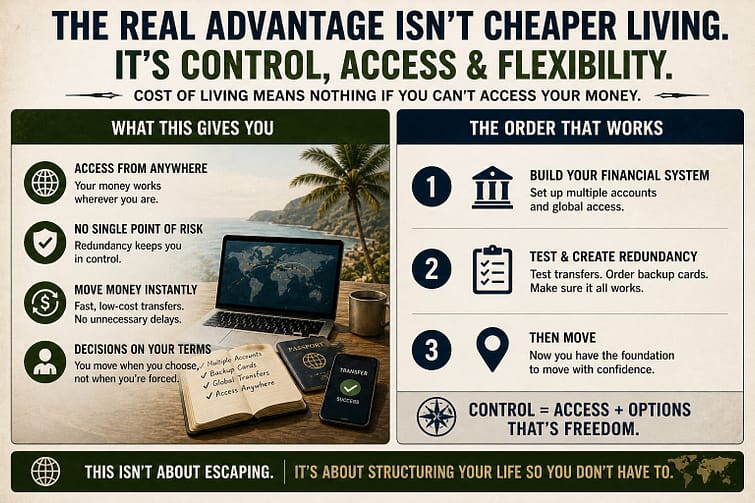
Cost of Living Means Nothing If You Can’t Access Your Money
People get obsessed with numbers.
“Thailand is cheaper.”
“Portugal is affordable.”
“Vietnam has low rent.”
That’s fine.
But if your bank flags your account and you can’t access funds for 72 hours, your cost of living doesn’t matter.
You’ve lost control.
The real advantage of geoarbitrage isn’t just lower expenses.
It’s flexibility.
And flexibility comes from systems—not locations.
Who This Actually Applies To
This isn’t for someone taking a two-week vacation.
This is for people who are serious about repositioning their life.
If you’re:
- Planning to stay abroad for months at a time
- Building or maintaining remote income
- Structuring a lifestyle across multiple locations
Then your money setup is not optional.
It’s foundational.
If you ignore it, you’ll feel it—just not immediately.
Most People Skip This Because It’s Not “Exciting”
Let’s be honest.
Opening accounts and testing transfers isn’t fun.
Booking flights is.
Looking at apartments is.
Planning your “new life” is.
But this is the part that determines whether that new life actually works.
Not the Instagram version.
The day-to-day reality.
The ability to pay, move, adjust, and stay flexible without stress.
That’s what this solves.
The Sequence That Actually Works
If you want this to run clean, the order is simple:
- Build your financial system
- Test it under real conditions
- Create redundancy
- Then move
Not the other way around.
Because once you move, you’re operating inside the system you built.
If it’s weak, you’ll feel it.
If it’s solid, everything else gets easier.
This Is About Control, Not Complexity
You’re not trying to outsmart the system.
You’re structuring around it.
Simple, clean, functional.
Enough redundancy that nothing breaks your flow.
Enough flexibility that you can move without hesitation.
That’s the goal.
And once you see it this way, you can’t unsee it.

John Rebell
John Rebell- Perpetual Traveler & Systems Strategist
I help people design location-independent lives that actually work—financially, logistically, and long-term.
